
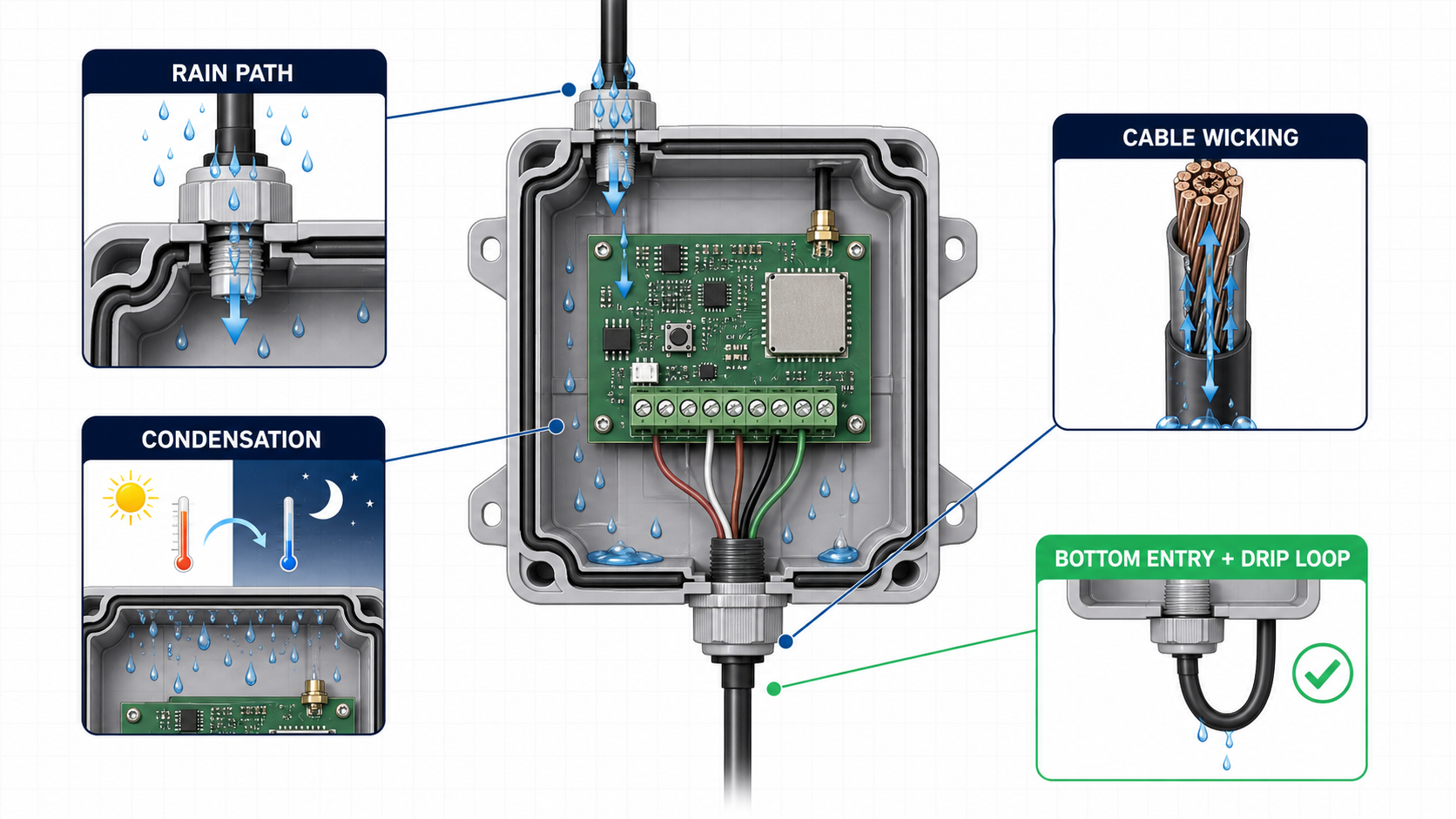
When an outdoor wireless control fails, the first report is usually short: “The receiver got wet.” In practice, I have opened plenty of failed panels that never saw a direct stream of water. The gasket looked fine, the lid screws were tight, and the enclosure was sold as waterproof. The real problem was moisture that entered through a cable, condensed from trapped air, or collected because the box was mounted in the wrong direction.
An IP-rated enclosure is useful, but it does not make an RF installation weatherproof by itself. Outdoor reliability comes from the complete assembly: enclosure, glands, cable routing, antenna, drainage, temperature cycle, and the way the installer closes the box after wiring.
Start by separating rain ingress from condensation
These two failure modes leave different clues and need different fixes.
Rain or washdown water normally follows a path. Look for a wet track below a lid joint, a loose gland, an unused knockout, a cable entering from the top, or water inside the cable jacket. The damage is often concentrated near the entry point.
Condensation is less obvious. You may find droplets across the inside of the lid, light corrosion on several connectors, or a receiver that works again after it has been dried. The enclosure can be perfectly sealed and still contain enough humid air to create water when the temperature falls below the dew point.
I have seen this often on gates, pumps, agricultural equipment, and rooftop controls. The cabinet heats in the sun, cools quickly after sunset, and “breathes” through small pressure changes. A few weeks of daily cycling can move more moisture than one heavy rainstorm.
The IP number applies to a tested enclosure, not every finished installation
IP65, IP66, and IP67 are frequently treated as a general promise that a product can live outdoors. They are actually test classifications under defined conditions. Drilling a hole, fitting the wrong cable gland, leaving a gasket dirty, or using a cable outside the gland’s clamping range changes the assembly.
Before installation, check five details:
The gland must match the actual cable diameter, not just the nominal thread size.
Every unused entry needs a rated sealing plug. Tape and silicone over an open knockout are temporary repairs, not production solutions.
The lid gasket must be continuous, clean, and compressed evenly. One over-tightened corner can distort a plastic lid enough to open another corner.
Screws and gland threads need the correct seals. Water can travel along threads that look mechanically tight.
The enclosure material must suit the environment. UV exposure, oil, salt, fertilizer, and cleaning chemicals can age plastics and seals much faster than indoor service.
Do not rely on a bead of sealant around everything. Sealant makes later service difficult, and it often hides a poor gland or distorted joint without correcting it.
Cable routing causes more trouble than most receiver boards
If a cable enters from above, it becomes a drainpipe pointed at the enclosure. Always prefer bottom or lower-side entries. Form a drip loop below the gland so water reaches the lowest point of the cable and falls away before it can reach the box.
There is another path installers often miss: water can move inside a cable. This happens through the space between conductors and jacket, especially when the far end is exposed or sits higher than the receiver. Tightening the gland around the outer jacket does not stop moisture already travelling inside it. In demanding installations, use a properly sealed cable, a resin barrier, or a suitable junction arrangement before the receiver enclosure.
Stranded wire also wicks moisture. If one end is in a wet limit switch, outdoor pushbutton, or sensor, corrosion can appear at the dry end months later. When the failure seems to “move” along the harness, cut back the wire and inspect the copper rather than replacing only the terminal.
A sealed box still needs a pressure strategy
For a small enclosure with occasional temperature change, a dry installation and a good seal may be enough. For a larger box exposed to sun, daily temperature swings, or altitude changes, pressure equalization deserves attention.
A hydrophobic breather vent can reduce pressure pumping while resisting liquid water. It should be sized and positioned according to the enclosure manufacturer’s instructions. A breather is not simply a hole drilled in the bottom.
Desiccant can help during commissioning or shipping, but it is not a permanent answer unless there is a maintenance plan. Once saturated, the packet becomes dead weight. Cabinet heaters are effective in some industrial panels because they keep internal surfaces above the dew point, but they require power, spacing, and thermal design.
Conformal coating adds useful protection against condensation and contamination on the PCB. It does not correct a flooded enclosure, an unsealed connector, or a relay carrying the wrong load. Coating should be treated as the last layer, not the first.
The waterproof box may be the reason the radio range collapsed
A plastic enclosure usually has a modest effect on an internal antenna, although carbon-filled plastics, wet surfaces, nearby wiring, and the mounting structure can still detune it. A steel cabinet is different. Put the receiver and antenna inside a closed metal box and you have built a very effective RF shield.
The common symptom is confusing: the system works with the cabinet door open during commissioning, then becomes unreliable after the door is closed. Do not immediately blame transmitter power or pairing. Test the complete installation with the lid closed and the machine running.
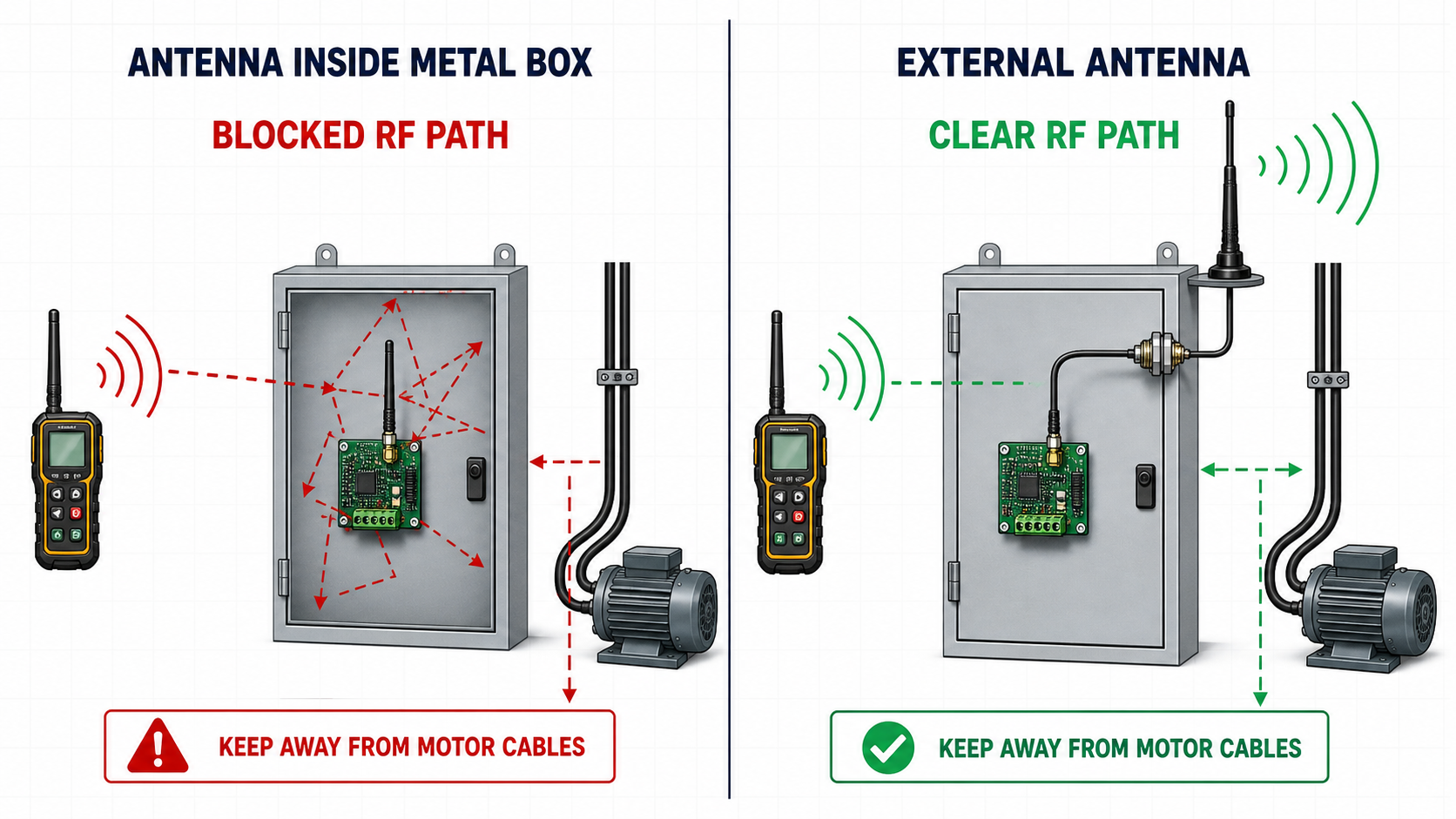
A closed steel cabinet can block the RF path. A bulkhead-mounted external antenna restores the link and keeps the antenna away from motor cabling.
For a metal enclosure, the normal solution is an external antenna installed through a suitable bulkhead feedthrough. Keep the antenna clear of large metal surfaces, motor cables, contactors, variable-frequency drives, and high-current conductors. Mount it in the orientation expected by the transmitter; mismatched antenna polarization can cost more range than many people expect.
A quarter-wave reference length is roughly 17 cm at 433 MHz, 8.6 cm at 868 MHz, and 8.2 cm at 915 MHz, but that does not mean every antenna should be cut to those dimensions. Helical, loaded, PCB, and matched antennas depend on their complete design and ground reference. Use the antenna specified for the receiver whenever possible.
Separate water damage from electrical damage
Outdoor failures are often blamed on moisture because corrosion is visible. Sometimes the corrosion is secondary and the original failure was electrical.
Long DC supply cables can produce voltage drop. Solenoids, motors, and contactors can create transients on the same supply. A receiver may reset exactly when its relay operates, which looks like weak radio control from the operator’s position. Measure the voltage at the receiver during switching, not only with the load idle.
Use the suppression required by the load: a flyback diode for a DC coil where polarity and release time permit, or the appropriate RC snubber, MOV, or manufacturer-recommended device for other loads. Keep load wiring away from the antenna and low-voltage receiver wiring. A waterproof enclosure does nothing to stop conducted noise.
A field inspection order that saves time
When I troubleshoot an outdoor receiver, I use the same order because it prevents random part swapping:
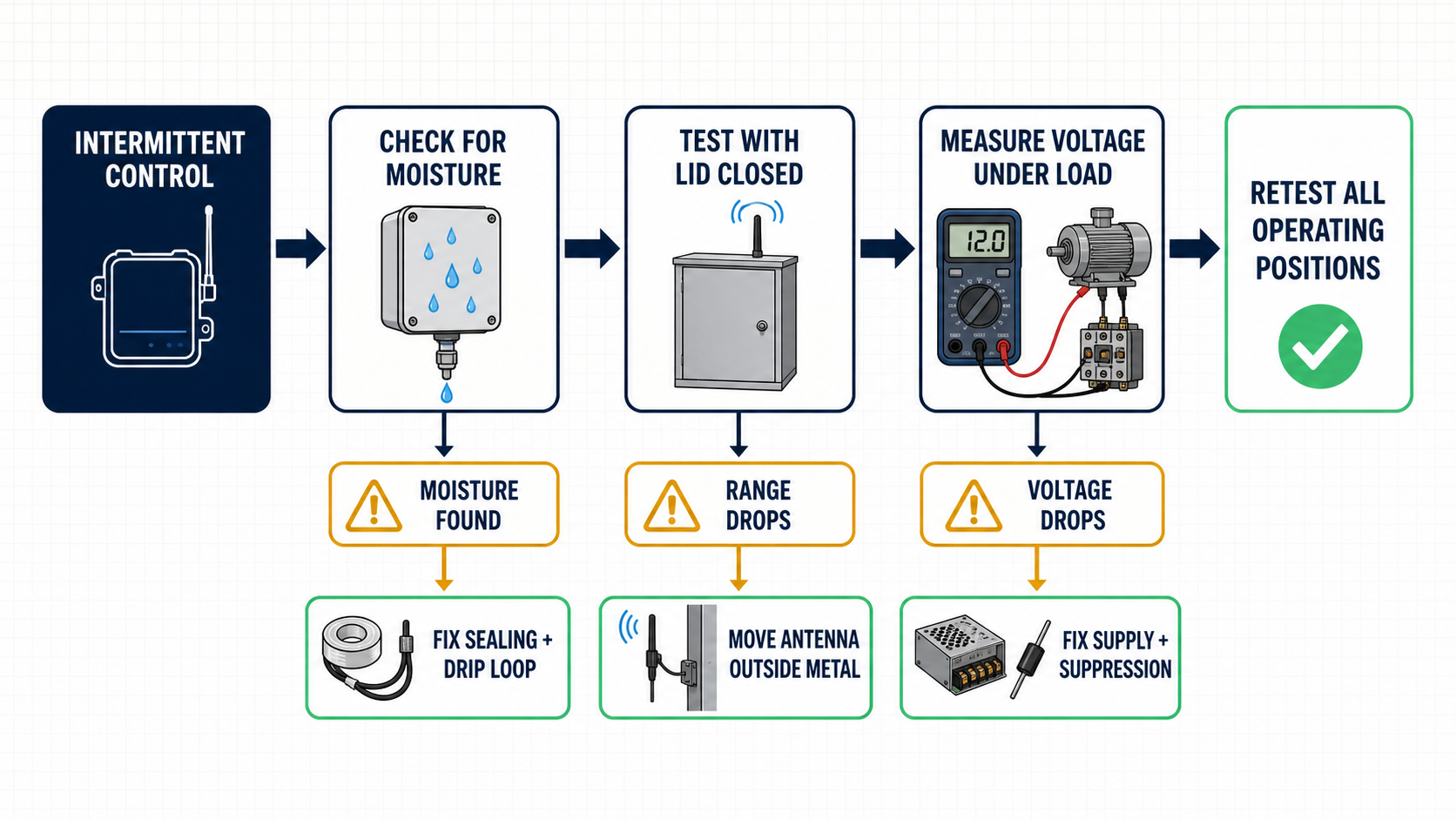
Use the failure pattern to separate moisture ingress, RF shielding and supply-voltage problems before replacing the receiver.
Record the weather, time of day, and machine state when the failure appears. Morning-only problems often point toward condensation; load-related problems point elsewhere.
Inspect cable entry direction, drip loops, unused holes, lid compression, and water tracks before disturbing the wiring.
Open the enclosure and look for droplets, mineral marks, green copper, white residue, and corrosion under removable terminals.
Check supply voltage at the receiver while the controlled load starts and stops.
Test radio operation with the lid closed, then compare it with the lid open. A large difference is an antenna-placement warning.
Move a known-good transmitter closer. If short-range operation is stable, investigate the RF path; if it still resets or chatters, investigate power and load wiring.
Dry the assembly properly before judging the repair. Moisture under connectors and relays can remain after the visible surfaces look dry.
After correction, run several full cycles and repeat the range test from the operator’s worst normal position.
What I would specify before ordering
For a new outdoor wireless-control project, “waterproof receiver” is not a complete requirement. I would ask for the operating temperature, enclosure material, actual cable diameters, entry direction, supply voltage, load type, switching current, mounting surface, required control distance, antenna location, exposure to washdown or chemicals, and whether the site has VFDs or large motors.
That information determines whether the job needs a receiver in a plastic enclosure, an external antenna through a metal cabinet, a pressure vent, coated electronics, sealed connectors, surge suppression, or a separate interface relay.
The important lesson is simple: outdoor RF reliability is an installation property. A good receiver can fail in a poor enclosure layout, and an expensive IP-rated box can create a radio problem if the antenna is trapped inside it. Design the moisture path, electrical path, and RF path together. That is what keeps the control working after the weather changes—not the word “waterproof” on one component.